HANDS-ON STEAM CURRICULUM


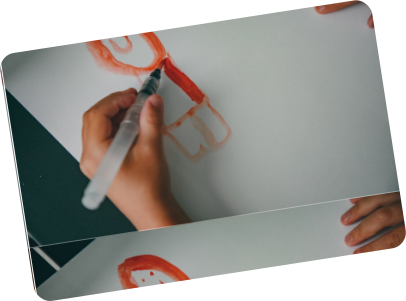
Children are natural scientists: constantly observing, experimenting, building, and asking “why?” Their brains are uniquely wired for exploration. Early childhood is a period of extraordinary neural growth, when pathways for creativity, reasoning, and problem-solving are developing at remarkable speed. Research shows that playful, hands-on learning in science, technology, engineering, arts, and mathematics (STEAM) during these early years lays a foundation for stronger thinking skills throughout life.
During the preschool years, children form mental frameworks that shape how they understand the world. High-quality STEAM experiences encourage them to test hypotheses, evaluate outcomes, collaborate with peers, and express complex ideas creatively. These habits of mind - curiosity, resilience, experimentation - are essential not only for school success but for navigating an increasingly complex and innovation-driven world.
At Curious Minds, children engage in daily STEAM-based exploration. Teachers guide students through interactive lessons using real tools, open-ended materials, and inquiry-driven activities. By the time students graduate from our Kindergarten Prep program, they have built simple machines, coded sequences with manipulatives, created artwork inspired by scientific ideas, measured and graphed classroom experiments, and developed the confidence to approach new challenges with enthusiasm.
Beyond being enjoyable and engaging, early STEAM education offers a wide range of cognitive, academic, and social benefits:

A longitudinal study of over 20,000 children found that early math and science skills were the strongest predictors of later school achievement - even more than early reading ability.¹
Researchers at Tufts University found that preschoolers who participated in engineering design challenges showed significant gains in reasoning, planning, and persistence compared to peers in non-engineering classrooms.²
A 10-year randomized trial across multiple U.S. schools demonstrated that arts-rich environments increased students’ creativity, empathy, and ability to generate original solutions - skills strongly linked to STEAM learning.³


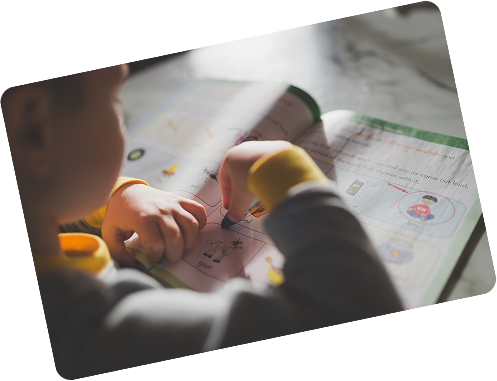

AT CURIOUS MINDS, EVERY DAY IS A CHANCE TO BUILD, CREATE, EXPERIMENT AND DISCOVER
We believe that children learn best when we fuel their natural curiosity through hands-on investigations.
Our teachers will guide students through units exploring the world around us (e.g. ocean life, grocery stores, pets) that will last a few days or a few weeks, depending on how students respond.
Our Preschool and Kindergarten Prep teachers dedicate daily time to worksheets developing early literacy and math skills, but our students will also enjoy plenty of time to play! After all, Einstein remarked, “play is the highest form of research.” The unfettered imagination and experimentation associated with play in a well-structured classroom allows children’s creativity to blossom.
It’s important to us at Curious Minds that our students have fun! When they enter Kindergarten with a love for learning and genuine excitement towards attending school, they are all-the-more likely to excel in the classroom, from elementary school through college.

1 Duncan, G. et al. (2007). School Readiness and Later Achievement. Developmental Psychology.
2 Bers, M. et al. (2013). Designing Digital Experiences for Positive Youth Development. Tufts University.
3 Bowen, D. & Kisida, B. (2019). Investigating Causal Effects of Arts Education. American Educational Research Journal.